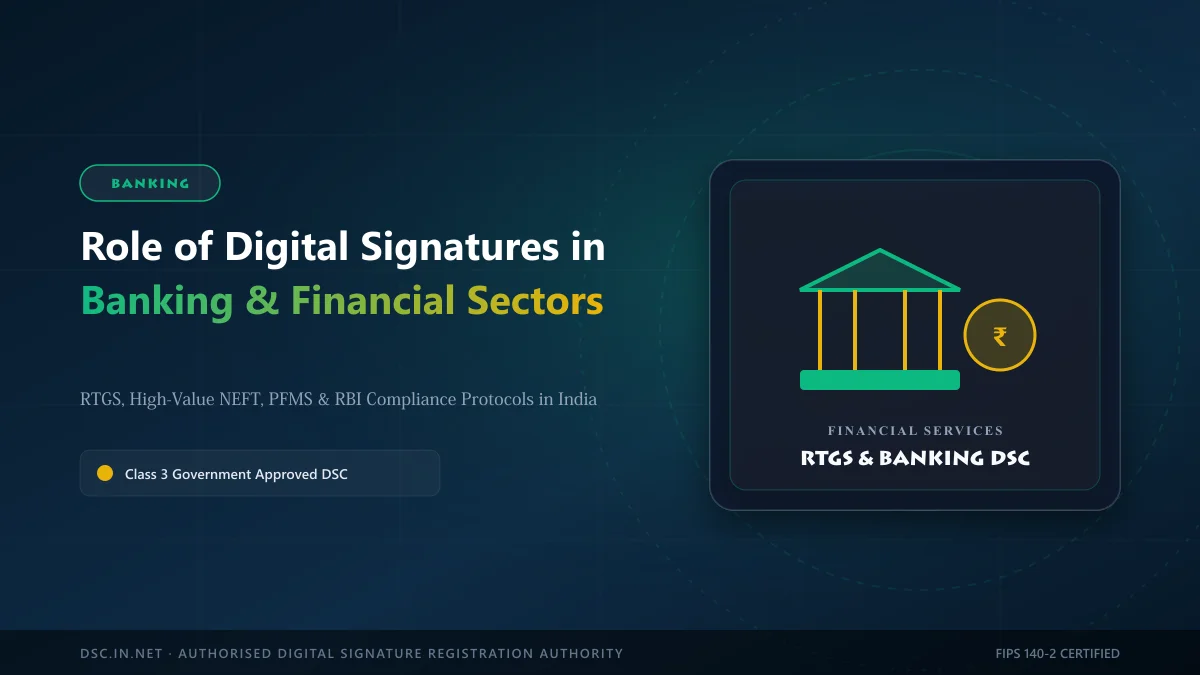
The Reserve Bank of India (RBI) and the Indian Financial Technology and Allied Services (IFTAS) enforce rigorous electronic authentication standards across national payment backbones. For commercial banks, non-banking financial companies (NBFCs), cooperative banks, and corporate treasury desks, Class 3 Digital Signature Certificates are the cornerstone of transactional security.
Primary Financial Use Cases for Class 3 DSC
In the banking sector, digital signatures are deployed across mission-critical systems:
- RTGS & High-Value NEFT Authorizations: Corporate treasury officers and authorized bank managers must digitally sign high-value transfer files before releasing funds on Structured Financial Messaging System (SFMS).
- PFMS (Public Financial Management System): Government nodal banks and beneficiary implementing agencies authenticate direct benefit transfers (DBT) and contractor payouts using Class 3 DSC.
- e-NACH & Digital Mandate Authorizations: Authenticating bulk recurring mandate batches on the National Payments Corporation of India (NPCI) clearing network.
- Digital Loan Agreements & Mortgages: Electronic signing of bilateral credit agreements, sanction letters, and hypothecation deeds with legally binding time-stamping.
Corporate Dual-Authorization Controls
Under corporate governance and RBI cyber security guidelines, high-value corporate treasury payments employ dual or triple signatory hierarchies:
- Maker DSC: Generates and uploads the transactional payment batch.
- Checker / Authorizer DSC: Independently reviews the transaction details and applies the second cryptographic signature before bank gateway processing.
Get Banking & Corporate Finance Class 3 DSC
FIPS 140-2 Level 3 cryptographic tokens customized for RTGS, SFMS, and PFMS authorizations.
Security Specifications for Financial DSCs
Banking applications strictly prohibit software-based certificates. All banking DSCs must reside on FIPS 140-2 Level 3 hardware tokens with SHA-256 asymmetric encryption and 2048-bit RSA keys. Furthermore, certificates must be issued under the Organization category containing the financial institution's legal name, corporate identity number (CIN), and designated officer credentials.
At DSC.in.net, we cater to premier banking institutions and treasury teams with compliant, high-security digital signature infrastructure.